Chartering and Managing Oil and Gas Tankers
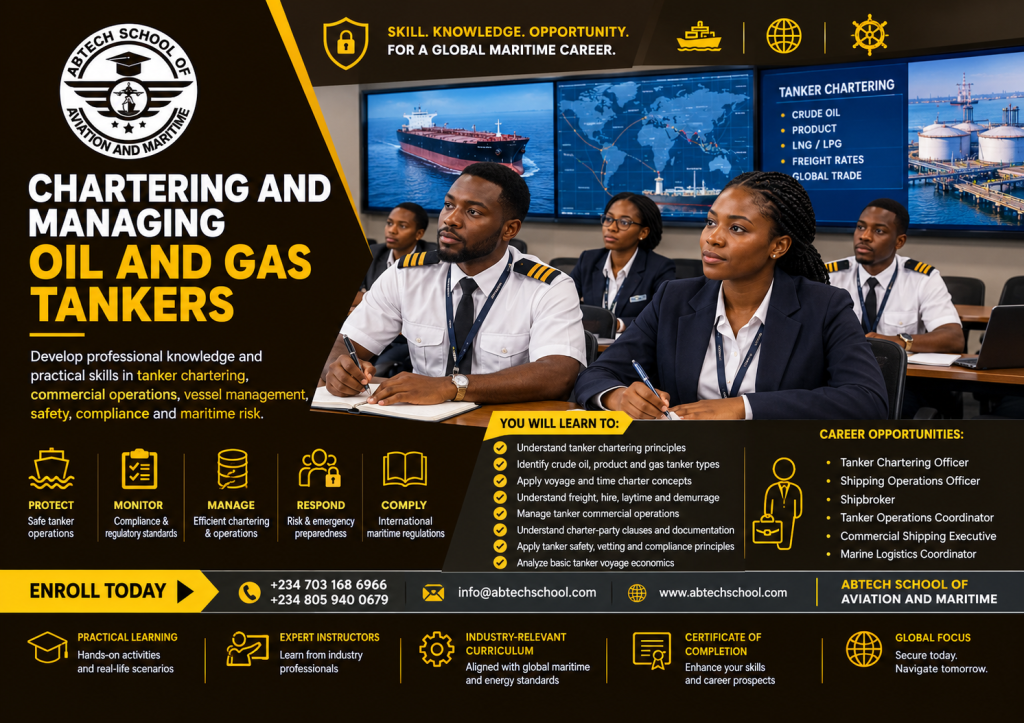
Chartering and Managing Oil & Gas Tankers is a professional maritime programme covering the commercial, operational, legal, financial, safety, regulatory and management aspects of tanker shipping. It introduces learners to tanker markets, charter parties, vessel employment, voyage planning from a commercial perspective, freight calculations, demurrage, documentation, ship management, vetting, compliance, environmental protection and risk management. The programme is designed around internationally recognized maritime frameworks and industry practices, including IMO requirements, SOLAS, MARPOL, the ISM Code, ISGOTT and OCIMF-related tanker-management practices. IMO identifies SOLAS and MARPOL as particularly important frameworks for tanker safety and pollution prevention, while the ISM Code establishes an international framework for safe ship management and pollution prevention. Recommended level: Professional / Advanced Diploma Suggested duration: 3–6 months Study mode: Physical, online or blended Target sectors: Shipping companies, tanker operators, chartering departments, ship agencies, oil-trading companies, ports, terminals, maritime consultancy and logistics organizations.
- Lessons
- 0
- Study time
- 90h:45m
- Enrolled
- 0
What you will be able to do
- Upon successful completion, learners should be able to:
- Explain the structure and operation of the international tanker shipping industry.
- Distinguish between major categories of oil and gas carriers.
- Explain the roles of shipowners, charterers, brokers, ship managers and cargo interests.
- Understand the fundamentals of tanker chartering.
- Identify the principal components of tanker charter parties.
- Explain voyage, time and bareboat chartering concepts.
- Understand tanker freight and hire calculations.
- Explain laytime, demurrage, despatch and detention concepts.
- Analyze basic tanker voyage economics.
- Understand bunker and port-cost considerations in voyage estimation.
- Prepare and review basic commercial voyage documentation.
- Understand the tanker nomination and fixture process.
- Explain the purpose of charter-party clauses.
- Understand tanker performance and vessel-description terminology.
- Explain the commercial importance of deadweight, draft, cargo capacity and vessel dimensions.
- Understand tanker market intelligence and freight-market terminology.
- Explain the relationship between tanker supply, cargo demand and freight rates.
- Understand ship-management structures and responsibilities.
- Explain the principles of tanker maintenance management.
- Understand crew-management responsibilities from a shore-management perspective.
- Explain the purpose of the Safety Management System.
- Understand the importance of ISM Code compliance.
- Explain the commercial significance of MARPOL and SOLAS requirements.
- Understand tanker vetting and inspection concepts.
- Explain the role of OCIMF and SIRE-related industry practices.
- Understand ship/shore interface management.
- Recognize the importance of risk assessment and safety-management systems.
- Understand oil-spill prevention and environmental-management principles.
- Explain tanker insurance and marine-liability concepts.
- Understand common tanker claims and dispute-management processes.
- Analyze basic tanker operating costs.
- Understand voyage profitability and chartering decisions.
- Communicate effectively with brokers, owners, charterers and ship managers.
- Prepare basic tanker chartering reports.
- Understand ethical, legal and compliance responsibilities in tanker shipping.
Curriculum
31 modules · 0 lessons · 0m
1 Introduction to Oil and Gas Tanker Shipping 0 lessons
2 Types and Classification of Tankers 0 lessons
3 Tanker Shipping Market 0 lessons
4 Introduction to Ship Chartering 0 lessons
5 Types of Charter 0 lessons
6 Tanker Charter Party 0 lessons
7 Tanker Chartering Negotiations 0 lessons
8 Tanker Voyage Estimation 0 lessons
9 Laytime, Demurrage & Despatch 0 lessons
10 Tanker Freight and Hire 0 lessons
11 Tanker Voyage Documentation 0 lessons
12 Commercial Tanker Operations 0 lessons
13 Tanker Ship Management 0 lessons
14 Tanker Maintenance & Asset Management 0 lessons
15 Tanker Safety Management 0 lessons
16 Maritime Regulatory Framework for Tankers 0 lessons
17 ISGOTT & Tanker/Terminal Management 0 lessons
18 Tanker Vetting Inspection 0 lessons
19 Ship/Shore Interface 0 lessons
20 Ship-to-Ship Operation Management-Inspective 0 lessons
21 Marine Insurance and Tanker Risk 0 lessons
22 Tanker Claims and Dispute Management 0 lessons
23 Environmental Management 0 lessons
24 Tanker Security & Compliance 0 lessons
25 Tanker Financial Management 0 lessons
26 Tanker Performance Management 0 lessons
27 Tanker Broking 0 lessons
28 Digital Technology in Tanker Management 0 lessons
29 Human Resources & Crew Management 0 lessons
30 Practical Chartering Case Studies 0 lessons
31 Final Project 0 lessons
About this programme
Oil and gas tankers are specialized vessels used to transport petroleum and other energy cargoes in bulk. Their employment involves significantly more than simply arranging a vessel and cargo. Successful tanker management requires coordination between shipowners, charterers, brokers, cargo interests, ship managers, masters, terminals, ports, insurers, classification societies, regulators and other maritime service providers.
This programme provides students with a structured understanding of how tanker voyages are commercially arranged and managed throughout the vessel’s employment cycle.
Students will study the principles of tanker chartering, including market research, vessel descriptions, cargo requirements, chartering negotiations, charter-party structures, freight, hire, laytime, demurrage, off-hire and voyage economics.
The programme also examines technical and operational management from a management perspective, including vessel maintenance, crew management, safety-management systems, inspections, vetting, environmental compliance, insurance, claims and emergency-management principles.
The safety component is particularly important because tanker operations involve significant hazards. ISGOTT provides industry guidance covering tanker and terminal operations, while the current sixth edition addresses areas including enclosed spaces, gas detection, petroleum-product hazards, static electricity, fire protection, cargo inspections and ship/shore interfaces.
The course does not replace mandatory STCW certification or specialized tanker-familiarization/advanced training required for personnel who physically serve aboard tankers. Those requirements depend on the person’s role, vessel type and applicable flag-state and STCW requirements. IMO confirms that STCW contains requirements specifically applicable to personnel working on tankers.
Related programmes
Ship Agency and Port Operations : Vessel Port Call Management
Proficiency Awareness for All Seafarer
Radar for Sailors and Boaters